SPC Flooring

Choosing the right flooring may be challenging since there are so many alternatives available, each with its own benefits. Stone Plastic Composite, or SPC, flooring is one choice that has grown in popularity recently. It combines durability, style, and practicality, making it a versatile choice for both home and business environments.

Stabilisers, polyvinyl chloride, and limestone powder are combined to create SPC flooring. Compared to regular vinyl or laminate, this special mix produces a stiff core that is significantly more sturdy. A high-definition printed layer that mimics the appearance of real wood, stone, or ceramic is placed on top, and it is shielded from scratches and normal wear by a clear wear layer. For added comfort and sound absorption, several designs additionally have a backing layer with an integrated underlay underneath.

Considering that SPC flooring is totally waterproof is one of its biggest benefits. SPC resists spills and humidity better than laminate, which can expand or distort when wet. For kitchens, baths, conservatories, and even basements, this makes it the perfect option. Because of its remarkable endurance, it can tolerate high foot traffic, dents, and scratches, which makes it ideal for both commercial and busy residential settings.

SPC flooring is valued for both its durability and lifelike patterns. Modern printing technologies allow it to faithfully capture the warmth of oak, the beauty of marble, or the roughness of slate for a fraction of the price and with far less maintenance. Click-lock technologies make it possible to quickly and easily install the planks, often directly over pre-existing flooring. To keep it in top condition every day, it just has to be swept and occasionally cleaned.

SPC is a sensible compromise when compared to other flooring options. It provides the warmth and cosiness that tiles occasionally lack, together with the natural appearance of hardwood without the cost or maintenance. It offers the guarantee of being longer-lasting and waterproof when compared to laminate.

To put it briefly, SPC flooring is an elegant, durable, and reasonably priced option that complements practically every environment. SPC provides all three in a creative package, whether you’re looking for the classic beauty of wood, the elegance of stone, or the durability to handle daily living.

Pallet racking inspection requirements

Is it a legal requirement to have an annual racking inspection?

Currently, there are no guidelines to say that it is a legal requirement to have an annual racking inspection. But, if you do not get your racking inspection on a yearly basis, you are breaching the advice from HSE’s.

The guide provided by HSE’s suggests that it is the warehouse owners legal responsibility to maintain the safety of their warehouse – which of course includes the racking as this can become a health and safety risk for employees working alongside and nearby the racking.

Why should I get a yearly racking inspection?

Many people question why they should get a yearly racking inspection as it is an additional cost for the company and if everything looks okay, it should be okay. But wrong! Here is why you should invest in carrying out annual racking inspections:

  • Saves the company money in the long run as any repairs can be fixed early.
  • Instead of having the whole racking system replaced because of one bit of damage that could have been fixed if found early, it is worthwhile.
  • Protects employee’s safety.
  • Ensures that palletised goods are safe.
  • Just because it looks safe, doesn’t mean it is.
  • You may not have noticed any damage that a racking inspection might.

Other inspections

As well as pallet racking, if your warehouse has any other storage systems installed in it, they will also need inspections to ensure health and safety for your employees and as well to protect the palletised goods. This includes a mezzanine floor, industrial shelving etc.

Forgings

Since 4000 BC, forging techniques have been practised in order to make tools and equipment used for day to day tasks. Now, over 6000 years later, we still use forging to create the tools and equipment we use in day to day life.

Find out more on what forging is and the different types of forgings available today.

Forging

What is forging?

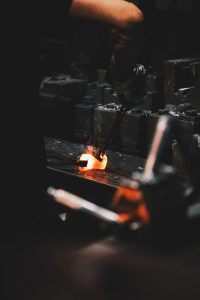
Forging is a process in which heated metal is reshaped using force. After pre-heating the metal, it is pressed into a tool which then causes the metal to take the shape of the specific tool used.

Compared to forging in 4000 BC, where they used rocks to shape the metal, forging is much more advanced in the 21st century.

Types of Forging

Hand forging

Blacksmithing, which is more commonly known as hand forging, is a manual method of forging. Just like any forging process, the metal is heated in order to allow for the shaping process to begin. In hand forging the pre-heated metal is beaten into its desired shape using a hammer against a metal anvil.

Due to using a manual process of forging, hand forging provides a superior grain when compared to other forging methods due to the bending of the metal whilst its hot. Due to this bending, it means the forged item is much stronger and lasts longer compared to other forging methods.

Upset Forging

Heading, which also has the name of upset forging, is one of the more common forging techniques used in today’s day and age.  The process involves a pre-heated bar which is position in between grooves whilst pressure is applied.

The dies applying pressure allow the hot metal to be shaped and in turn, the desired design can be achieved.

forgings                     forging

Drop Forging

Drop forging is a processed used in machine forging. This forgings process consists of a hammer which is dropped onto a heated piece of metal in order to shape it. Within drop forging there are two popular types of forging; Open die forging and Closed die forging.

Open die forgings are where the metal is placed on a stationary anvil and then shaped using the hammer. It gets its name ‘Open Die’ as the die does not fully enclose the metal when it is being forged.

Closed die forgings are different to open die in the respect that the dies are a fixed structured and therefore close around the metal when the pressure is being applied.